


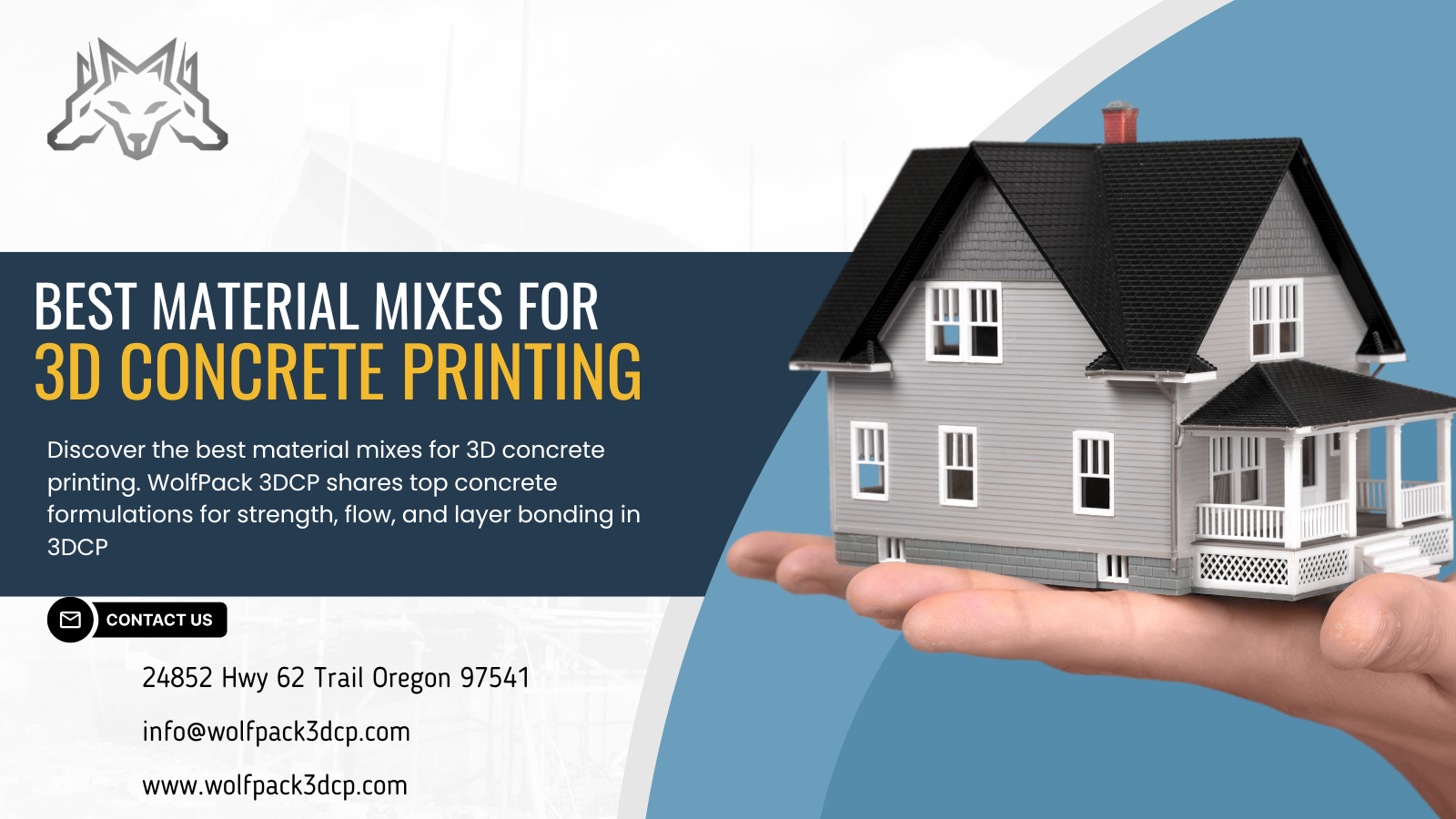
The success of 3D concrete printing (3DCP) largely depends on the material used. A well-designed concrete mix ensures smooth extrusion, fast setting, strong layer bonding, and long-term durability. WolfPack 3DCP specializes in providing advanced materials engineered for industrial-scale 3DCP projects, enabling faster construction, lower waste, and stronger structures.
This guide explains the best material mixes for 3D concrete printing, including properties, composition, and practical considerations for builders.
Why Material Mix Matters in 3DCP
3DCP differs from traditional construction methods because concrete is extruded through a nozzle, layer by layer. If the material is not optimized:
- Layers may collapse
- Cracking can occur
- Flow may be inconsistent
- Final strength can be compromised
WolfPack 3DCP materials are formulated to provide:
- High compressive strength
- Excellent workability and flow
- Rapid setting without shrinkage
- Reliable adhesion between layers
Choosing the right mix is essential for successful 3DCP construction.
Key Properties of 3D Printable Concrete
- Flowability (Pumpable Concrete)
- Material must flow easily through hoses and nozzles.
- Too thick = clogging; too thin = sagging.
- WolfPack 3DCP mixes ensure precise flow for continuous printing.
- Early-Stage Strength (Fast Setting)
- Layers must support subsequent layers without collapsing.
- Fast-setting concrete reduces waiting time between layers.
- Compressive Strength
- 3DCP structures require high load-bearing capacity.
- WolfPack 3DCP mixes achieve 30–50 MPa compressive strength.
- Layer Bonding
- Adhesion between layers is critical to prevent delamination.
- WolfPack 3DCP formulations provide chemical and mechanical bonding for durability.
- Shrinkage & Crack Resistance
- Controlled water-to-cement ratio and additives minimize shrinkage.
- Reinforcement fibers improve toughness and flexibility.
Components of a High-Quality 3DCP Mix
1. Cement
- Ordinary Portland Cement (OPC) or blended cements are commonly used.
- Provides structural strength and quick setting properties.
2. Fine Aggregates (Sand)
- Sand improves flow and reduces voids in the mixture.
- Well-graded sand ensures smooth extrusion.
3. Admixtures
- Superplasticizers: Improve workability without adding water.
- Accelerators: Reduce setting time for faster printing.
- Retarders: Control setting time in hot climates.
- Viscosity Modifiers: Maintain layer stability and prevent sagging.
4. Water
- Water-to-cement ratio is critical (usually 0.28–0.35) to balance flow and strength.
5. Fibers
- Polypropylene or glass fibers improve toughness and crack resistance.
- Prevent delamination and enhance durability.
6. Supplementary Materials
- Fly ash, silica fume, or slag can enhance strength, reduce shrinkage, and improve workability.
Popular 3DCP Mix Designs
1. Standard 3DCP Mix
- Cement: 50–60%
- Sand: 35–45%
- Water: 28–32%
- Admixtures: 2–5%
- Optional fibers: 0.5–1%
Use: Residential walls, basic structures.
2. High-Strength Mix
- Cement: 60–65%
- Sand: 30–35%
- Water: 28–30%
- Superplasticizers: 3–5%
- Fibers: 1–2%
Use: Load-bearing walls, multi-story buildings.
3. Fast-Setting Mix
- Cement: 55–60%
- Sand: 35–40%
- Water: 28–30%
- Accelerators: 2–4%
- Fibers: 0.5–1%
Use: Projects requiring rapid layer printing, e.g., emergency housing or fast builds.
4. Eco-Friendly Mix
- Cement: 40–50%
- Sand: 35–40%
- Fly ash or slag: 10–15%
- Water: 28–30%
- Admixtures: 2–4%
Use: Sustainable buildings with lower CO₂ emissions.
Tips for Optimizing 3DCP Material Mix
- Conduct Trial Prints
Test mix on small samples before full-scale printing. WolfPack 3DCP provides trial support for optimal settings. - Adjust Water-to-Cement Ratio
Higher ratios increase flow but reduce strength. Lower ratios improve stability but may clog nozzles. - Use Admixtures Wisely
Balance accelerators, retarders, and superplasticizers based on environmental conditions and layer height. - Include Fibers for Strength
Prevent cracks and improve durability, especially for multi-story constructions. - Monitor Temperature and Humidity
Environmental conditions can affect flow, setting, and curing. Adjust admixtures accordingly.
WolfPack 3DCP Material Advantage
- Engineered for Industrial Use: Consistent quality for large-scale projects.
- Rapid Curing: Reduces printing downtime.
- High Structural Strength: Meets international construction standards.
- Optimized Layer Bonding: Smooth and durable 3D prints.
- Technical Support: Mix design advice and onsite consultation.
With WolfPack 3DCP, builders can confidently print strong, durable, and aesthetically superior homes.
Conclusion
The best material mixes for 3D concrete printing combine flowability, fast setting, high compressive strength, and excellent layer bonding. WolfPack 3DCP provides advanced, industrial-grade concrete formulations and support to ensure every print is strong, precise, and reliable.
Choosing the right mix is the foundation for successful 3DCP projects, enabling builders to reduce waste, save time, and achieve durable, modern construction.