


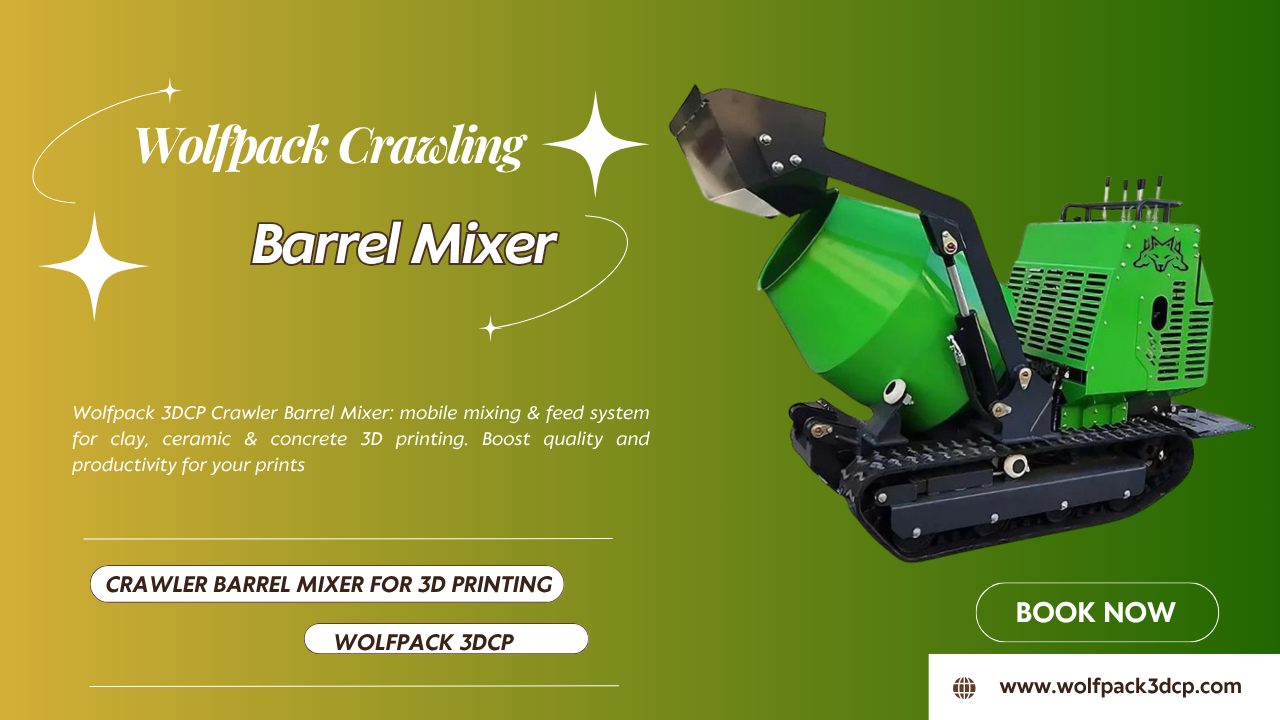
As the world of additive manufacturing continues to evolve, handling materials like clay and concrete for 3D printing presents special challenges—especially when it comes to mixing, feeding and managing heavy paste or slurry. The Wolfpack 3DCP Crawling Barrel Mixer (CBM) is designed to meet those challenges head-on, delivering a robust feed and mixing system for 3D printers working with heavy pastes, concrete mixes, or clay slurries.
In this article we’ll explore:
- What exactly the Crawling Barrel Mixer is and why it matters
- How it works, and its key technical features
- Which applications benefit most
- Key considerations before purchase
- Why the Wolfpack 3DCP option stands out
What is a Crawling Barrel Mixer?
A crawling barrel mixer is a material handling and feed system designed for 3D printing processes that demand heavier materials than typical plastics. In practice it involves:
- A barrel or drum that mixes the heavy paste/slurry material to ensure consistent viscosity and flow
- A crawler or tracked platform (hence “crawling”) that allows mobility or precise positioning near the 3D printer or print site
- A continuous or controlled feed mechanism so that the printing machine receives material at the correct pressure/flow rate
- Integration with the printer’s control system so the feed rate matches the printing rate
For 3D printing of concrete, ceramics or large‐scale structures, the ability to maintain consistent material properties (flow, cohesion, setting time) is critical. Without a dedicated mixer/feed system you risk clogs, poor layer bonding, excessive shrinkage or failure. The Wolfpack Crawling Barrel Mixer bridges that gap.
How Does It Work?
1. Material Loading & Mixing
The barrel mixer is charged with the raw material—whether a high‐viscosity clay paste, ceramic slurry, or a concrete/mortar mix designed for extrusion. The mixing system ensures uniform dispersion of aggregates, binders, and additives.
2. Mobility & Positioning
Because large printing systems may occupy significant space, the “crawling” platform enables the mixer to be moved into optimal position relative to the printer’s extruder or feed hose. This allows flexibility on the shop floor or job site.
3. Controlled Feed to the 3D Printer
The mixer delivers material via a pump or auger mechanism into the extruder of the 3D printer. Key parameters include:
- Flow rate (volume per minute)
- Pressure or torque required to push the material
- Synchronisation with print speed and layer build rate
- Minimisation of air entrainment (which can cause defects)
4. Monitoring & Control
Advanced systems include sensors to monitor material consistency, flow rate, barrel rotation speed, temperature (for slurries that heat up) and integration with the printer’s software to ensure feed matches print demand.
Key Benefits
- Higher productivity: Ready mixing and continuous feed reduces downtime compared to manual mixing and refill cycles.
- Better print quality: Consistent material properties lead to stronger bonding between layers, fewer defects and higher structural integrity.
- Scalability: Particularly for large-format printing (architecture, construction, large ceramic vessels) the mixer/feed system becomes a critical enabler.
- Flexibility: The mobile crawler base allows integration in various environments—workshops, studios, construction sites.
Typical Applications
The Crawling Barrel Mixer serves a number of areas, including:
- Large‐scale concrete 3D printing for construction façades, architectural elements, or structural components.
- Ceramic and clay 3D printing when using heavier or more aggregate‐rich slurries for design objects, prototypes or production pieces.
- Research and development labs exploring novel materials (e.g., fibre‐reinforced concrete, geopolymer slurries).
- Maker studios or educational facilities where material experimentation and feed control are required.
Why Choose the Wolfpack 3DCP Crawling Barrel Mixer?
Here’s how this specific model stands out:
- Built by Wolfpack 3DCP — a brand known for combining industrial-grade robustness with usability for smaller studios/makers.
- Designed for compatibility with clay, ceramic and concrete 3D printing workflows.
- Mobile crawler base means you don’t have to build a fixed mixing station—flexible layout options.
- Optimised feed control system, supporting consistent extrusion and fewer material‐related print issues.
Things to Consider / Buyer Checklist
Before you invest in a barrel mixer for your 3D printing workflow, assess the following:
- Material compatibility: Confirm that the mixer supports the exact type of material you intend to use (viscosity, aggregates, additives).
- Feed rate vs printer speed: Ensure the mixer’s output matches your 3D printer’s build rate to avoid starvation or overflow.
- Mixing capacity & volume: Pick a barrel size that suits your job scale—too small leads to frequent refills, too large might waste material.
- Mobility & footprint: The crawler base helps, but you still need sufficient floor space and access paths.
- Software & integration: Does the mixer communicate/control via the same platform as your 3D printer? Is monitoring available?
- Maintenance & cleaning: Heavy‐material mixers need regular cleaning, inspection of seals/augers, and possibly heating/cooling controls if slurries heat up.
- Cost vs benefit: While an integrated mixer adds cost, the efficiency gains, print quality improvements and fewer failures often justify the investment.
Future Outlook
As 3D printing technologies for ceramics and concrete expand, we expect to see:
- More rapid integration of mixers/feed units with printers—moving toward “all‐in‐one” systems.
- Smart monitoring of material rheology (flow behaviour) in real time, adjusting feed on-the-fly.
- Use of more complex materials (reinforced slurries, multifunctional composites) that demand even better mixing control.
- Increased adoption of mobile mixing stations (like crawler mixers) for on-site construction printing projects.
Conclusion
For professionals and makers working in terrain where material feed is just as important as print geometry, the Wolfpack 3DCP Crawling Barrel Mixer is a game-changer. Whether you’re printing large concrete structural forms or artisan ceramic work using heavy paste, a reliable mixing and feed system is the backbone of success.


