

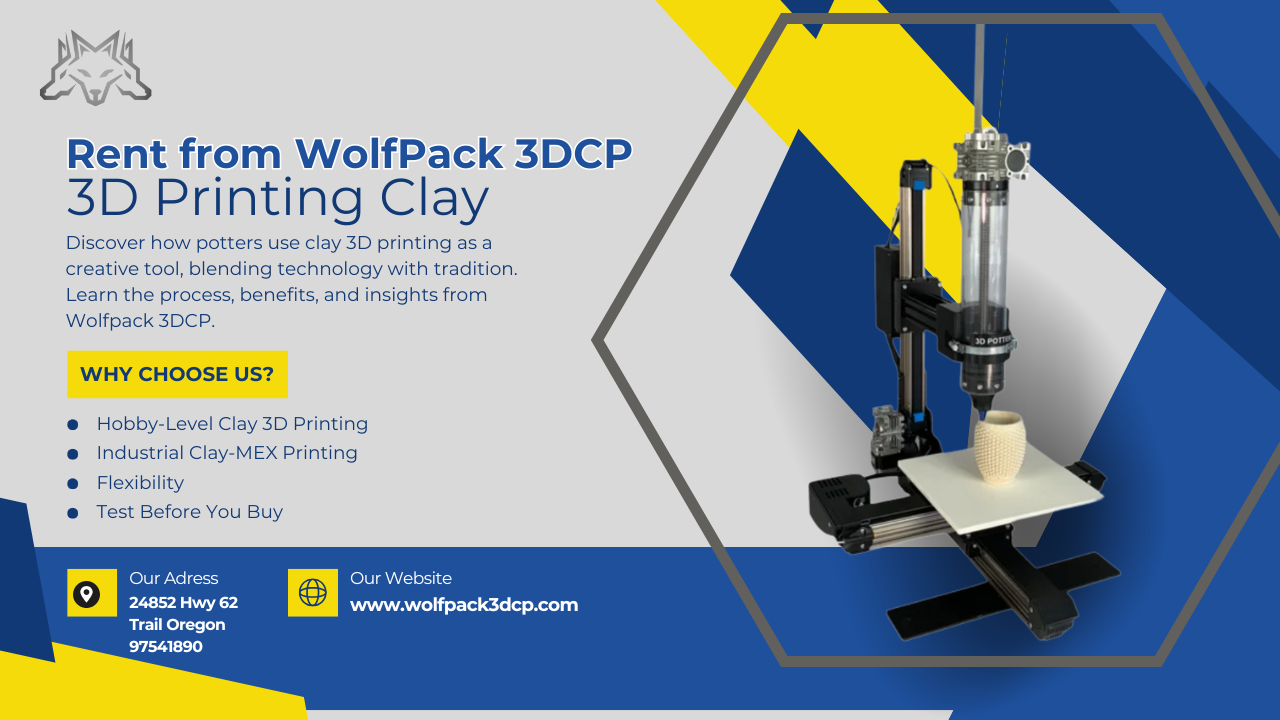
Clay 3D printing has become a growing topic in modern ceramics, sparking conversations among traditional potters and technology-driven makers. Many potters view it with curiosity, others with skepticism — but once you understand the process, it becomes clear that clay 3D printing is simply another creative tool, not a replacement for craftsmanship.
As someone who has worked with traditional clay techniques like hand-building and wheel throwing, I’ve experienced both the physical demands of pottery and the excitement of new technology. Clay 3D printing entered my life when injury limited my wheelwork, pushing me to explore digital tools as a new way to continue creating.
Just like mastering the pottery wheel, clay 3D printing has its own learning curve. Preparing clay for extrusion, understanding CAD design, adjusting machine pressure, and testing clay consistency are all part of the process. When I purchased my first clay 3D printer in 2021, it took months of experimentation before I could create reliable, predictable forms.
Despite misconceptions, a clay 3D printer is simply a tool — no different from a kiln, a wheel, or a mold. It requires skills, patience, and knowledge of clay behavior. A potter still needs to understand drying, trimming, surface work, glazing, and firing. Clay 3D printing simply adds digital shaping to the long list of ceramic-making methods.
A surprising fact is that many early clay printers were invented by artists, not engineers. Their curiosity and experimentation paved the way for the tools we use today.
Artists Who Pushed Clay 3D Printing Forward
Jonathan Keep, one of the earliest names in clay 3D printing, built his own ceramic 3D printer and made the instructions open-source — helping thousands of potters worldwide explore digital ceramics. His work helped normalize clay 3D printing as a natural progression in pottery’s evolution, just like the introduction of the electric wheel.
Taekyeom Lee, an award-winning designer, saw clay as “physical typography.” Treating clay like a form of ink, he pushed boundaries with letterforms, textures, and abstract shapes. As he once said, “If Da Vinci had access to these tools, wouldn’t he use them?” — a question that makes you reflect on how art evolves.
Wheel Throwing vs. Clay 3D Printing: Different Tools, Same Intent
While the techniques appear worlds apart, the process shares many similarities.
A potter using a wheel centers clay, adjusts speed, and shapes the form with controlled pressure. After shaping, the piece must dry, be trimmed, decorated, and fired.
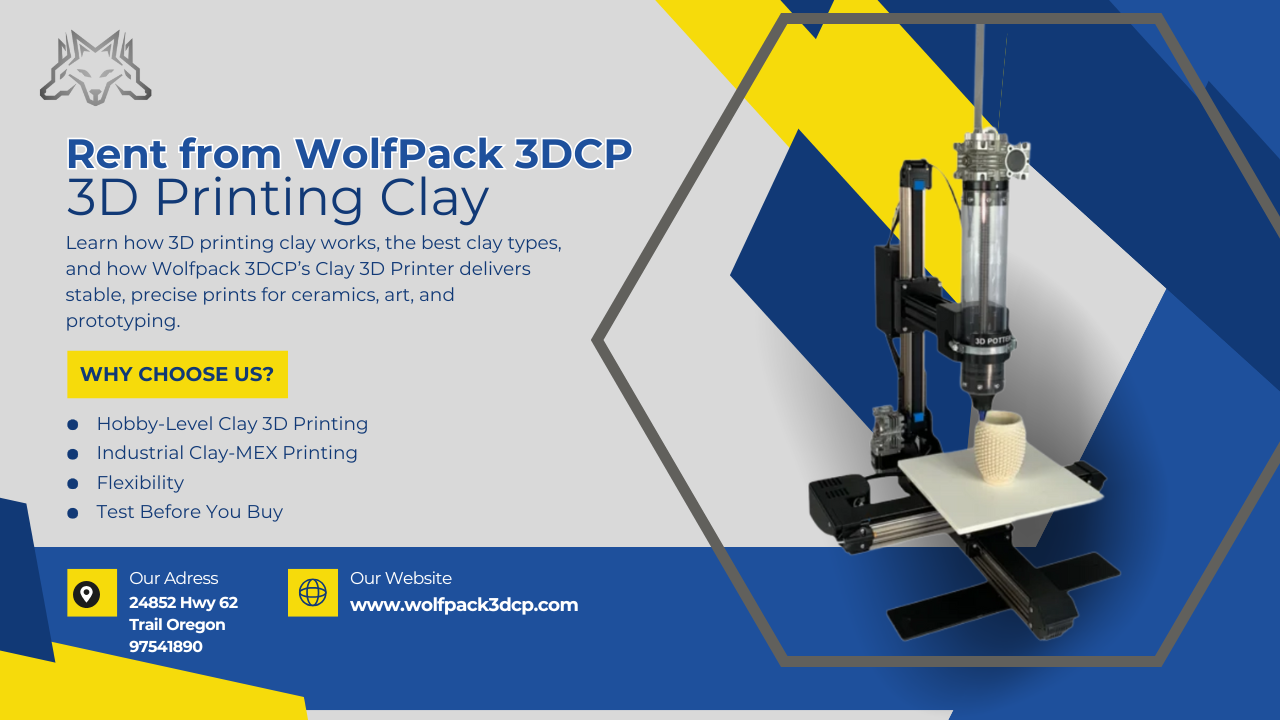
A potter using a clay 3D printer begins by sculpting the form digitally in CAD. The printer settings — speed, extrusion, wall thickness — influence accuracy, just like wheel speed and hand pressure do. Clay is compressed into the cartridge, then extruded in coils layer by layer. After printing, the piece must dry, be refined, decorated, and fired.
In many cases, 3D printing clay actually takes longer than wheel throwing. It is not mass production — it is still craftsmanship, simply with different tools.
Artists Embracing Digital Ceramics
Tom Lauerman, a professor at Penn State, spent years perfecting geometric clay forms. His early attempts at high-precision, plastic-like prints were criticized — yet he persisted, proving that clay can also be engineered with accuracy and intention. His dedication showed that clay 3D printing is both artistic and highly technical.
Marlieke Wijnakker, co-founder of VormVrij®, uses 3D scans and clay printers to create sculptural busts. After printing, she hand-sculpts details the printer cannot capture. This blend of digital and traditional techniques results in expressive, highly detailed ceramic portraits.
Ryan Barrett, known for vibrant layered works, built his own ceramic printer after winning “The Great Pottery Throwdown.” His pieces include over 10,000 clay coils, creating forms that resemble woven textiles or tapestries — proving how 3D printing can inspire entirely new visual languages.
Why Clay 3D Printing Matters
Artists who move between traditional and digital techniques expand the definition of ceramics. You don’t have to prefer clay 3D printing, but understanding it opens the door to innovation and collaboration.
Clay has always behaved unpredictably — cracking, warping, shrinking, exploding — no matter how experienced the potter is. Whether shaped by hand, wheel, or machine, clay retains memory, attitude, and character.
Clay 3D printing doesn’t erase tradition; it builds on it.
Wolfpack 3DCP and the Future of Clay Printing
At Wolfpack 3DCP, we support potters, designers, and artists exploring the next chapter of ceramics. Our clay 3D printers are built for stability, consistent extrusion, and ease of use — offering a modern tool for anyone ready to explore digital craftsmanship.
Clay 3D printing may not replace traditional methods, but it expands what’s possible. And that is exactly how pottery has evolved throughout history.
FAQs
1. What is clay 3D printing?
Clay 3D printing is a digital technique that extrudes clay in layers to build forms. It works like traditional coiling but is automated through a 3D printer. Potters still trim, refine, glaze, and fire pieces as usual.
2. Is clay 3D printing easier than wheel throwing?
Not necessarily. Clay 3D printing has its own learning curve, including CAD design, clay preparation, machine calibration, and understanding extrusion settings.
3. Do I need experience with pottery to use a clay 3D printer?
Basic knowledge of clay behavior, drying, and firing is very helpful. A 3D printer is a tool — but clay still needs to be dried, refined, decorated, and fired properly.
4. Does clay 3D printing replace traditional pottery?
No. Clay 3D printing is simply another creative tool. Many artists combine hand-building, wheelwork, and digital printing to expand their artistic range.
5. What clay works best for 3D printing?
Smooth, plastic clays with consistent moisture work best. Avoid grog-heavy clay bodies, as they can clog extruders. Many potters prefer porcelain or stoneware bodies with fine particles.
6. How long does a clay 3D print take?
Depending on size and design, prints may take hours or even days. Clay 3D printing is not mass production — it is slow, precise craftsmanship.
7. Can I sculpt or refine a 3D-printed piece?
Yes! After printing, you can smooth, carve, trim, decorate, and finish the piece just like any handmade ceramic work.
8. Does Wolfpack 3DCP offer clay printers for artists?
Yes. Wolfpack 3DCP provides reliable clay extrusion printers built for potters, designers, and studios exploring digital ceramic techniques.